Inspection, Testing & Assaying
Witnessed Gold Melting & Melt Sampling
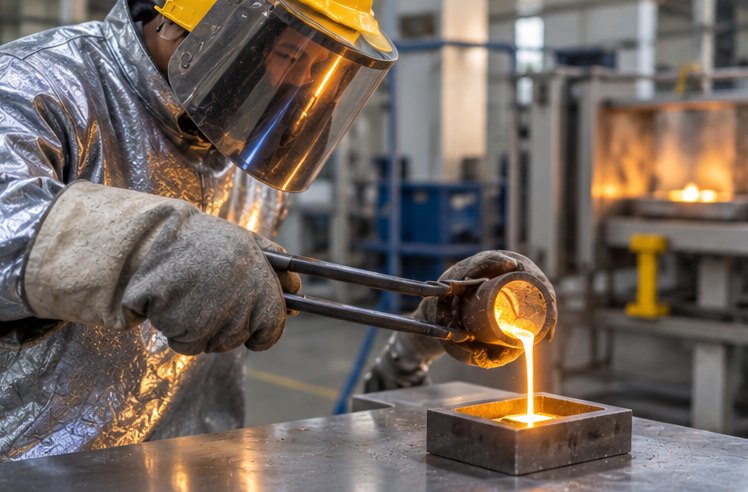
Unmelted gold is hard to value and easy to argue over. A witnessed melt turns it into a single bar whose assay sample comes from the molten metal itself — so the laboratory result describes the whole bar, and the bar that changes hands carries its own assay.
Scope
- Turnaround
- Melt record on the day; assay as the laboratory schedules it.
- Coverage
- 7 countries, and anywhere in Africa
- Standards
- Inspection to the requirements of ISO/IEC 17020; laboratories accredited to ISO/IEC 17025
Alluvial gold, dust, nuggets and scrap contain moisture, sand, other metals and sometimes deliberate additions. Their true content cannot be read reliably from the surface. Melting removes the loose impurities and produces one homogeneous piece.
Our tester attends the melt at a licensed refinery or smelting facility from start to finish: the material is weighed going in, the furnace is observed, the sample is drawn from the melt, and the bar is weighed, photographed and sealed. The loss in weight is recorded so that both sides can see where it went.
The sample goes under seal to an accredited laboratory for fire assay, and the bar can then be valued on its weight and its assayed content.
Typical situations
- Before buying or selling alluvial, dust or scrap gold
- When a buyer requires a bar with an assay tied to it
- When jewellery or scrap must be turned into a tradable bar
Method
Our testers and inspectors are based in Tanzania, Kenya, Uganda, Zambia, the DR Congo, Ghana and Sierra Leone, and deploy with XRF analysers wherever in Africa the material is held.
- STEP 01
Book the melt
The material, the quantity, where it is held and the facility you prefer, if any.
- STEP 02
Weigh in
The material is weighed on a calibrated scale in front of our tester and the owner.
- STEP 03
Melt and sample
The gold is melted at the licensed facility and the assay sample taken from the melt.
- STEP 04
Weigh out and seal
The bar is weighed, numbered, photographed and sealed; the weight loss is recorded.
- STEP 05
Assay
The sealed sample goes to the laboratory, and the full melt record is issued to you.
Scoping is free. We return a scope, timetable and terms within one business day.
Request this service
Detail
Why weight is lost in the melt
Melt loss is the difference between the weight of material put into the furnace and the weight of the bar. It comes from moisture, sand, base metals that oxidise into slag, and in the case of dust, any filler added to it. Losses on alluvial gold are routinely significant. Recording both weights in front of the parties removes the commonest source of dispute.
Deliverables
- Weights before and after the melt, with the loss recorded
- Bar number, seal number and photographs
- Fire assay result for the sample taken from the melt
- A signed melt record witnessed by our tester
Turnaround. Melt record on the day; assay as the laboratory schedules it.
Why clients choose us
- A tester present for the whole melt, not just the result.
- The sample is drawn from the melt and sealed before it leaves the furnace room.
- Nairank Global is independent of buyers and sellers. Its fees are outcome-neutral: they are the same whether or not the transaction proceeds. Our fee is agreed before work starts and is the same whatever we find.
Questions
Not answered here? Message the desk.
Where are melts carried out?
At licensed refineries or smelting facilities, agreed in the scope, with our tester present throughout.
Why sample from the melt and not the bar?
Molten gold is mixed, so a sample from the melt represents the whole bar. A sample cut from a cooled bar can differ from its interior.
Will the bar weigh less than the material?
Almost always. Moisture, sand and base metals are removed in the melt. Both weights are recorded so the loss is documented.
Can the owner attend?
Yes. The owner or the buyer’s representative may attend and sign the melt record.
Do you melt the gold yourselves?
No. The melt is carried out by the licensed facility. We witness, record, sample and seal.
Can you value the bar afterwards?
Yes. Once the assay is issued, the bar can be valued on its weight and fine content under our gold valuation service.
Where we provide this
City and country pages with local detail: where our teams work, the authorities involved and how an engagement runs there.
- Gold testing in Dar es SalaamXRF, acid and density testing at dealers, vaults and the airport, with fire assay and sealed lots.
- Gold testing in MwanzaTesting at Lake Zone mineral markets, dealers and refineries, with witnessed melts and fire assay.
- Gold testing in GeitaGold tested at source in Geita, with inspection of the producing site and sealed lots.
- Gold testing in KampalaTesting at dealers, refineries and Entebbe airport, with seller licence checks.
Related practice areas
Gold Testing & Assaying
Gold Valuation
Additional Inspection & Technical Services
Field guidance
Country pages and buyer guides where this work applies.
- Tanzania — Dar es Salaam, Mwanza, GeitaXRF, density and fire assay in Dar es Salaam, Mwanza and Geita, with BRELA and Mining Commission checks on the seller.
- Uganda — Kampala, Entebbe, MubendeIndependent testing of incoming lots for refineries, witnessed melts and supplier checks; refinery certificate checks for buyers.
- Gold refineries in UgandaThe refining sector, the Bank of Uganda programme, and the checks that apply whether you supply, buy from or run a refinery.
- Gold testing methods comparedWhat XRF, acid, density and fire assay each measure, their limits, and how they are combined.
Gold Melt Supervision & Sampling
Brief us on the requirement and the location. We return a scope, a timetable and terms within 24 hours, in confidence.