What is gold buyer due diligence?
Gold buyer due diligence is independent verification of a gold seller and the gold it offers, carried out for the buyer before money moves. It answers four questions: who the seller is, whether it may lawfully sell gold, whether it holds the gold it is offering, and whether that gold is what the documents claim.
Each answer comes from the source — the national companies registry, the mining or dealer licence authority, the vault or refinery that issued a document, and the gold itself on a scale and under an XRF analyser. A seller’s own papers are the starting point of the check, never its conclusion.
Why do gold deals in Africa go wrong?
Most failed gold purchases fail before any gold moves. The common patterns are the same across the continent:
- A company that is registered but holds no licence to deal in or export gold.
- A licence that exists but belongs to a different company, or has expired.
- Documents — an SKR, an assay certificate, an export permit — that the named issuer never issued.
- Fees requested for “registration”, “release” or “insurance” before the buyer has seen the gold.
- Gold that is real but plated, tungsten-cored or lower in fineness than stated.
Every one of these can be found before payment, by checking the record and the metal rather than the paperwork that describes them.
How do you verify that the gold seller is a real company?
We obtain the seller’s record from the national companies registry of its country — BRELA in Tanzania, the Business Registration Service in Kenya, URSB in Uganda, the RCCM in the DR Congo, PACRA in Zambia, the Office of the Registrar of Companies in Ghana and the Corporate Affairs Commission in Sierra Leone. The record shows whether the company exists, who its directors and shareholders are, and whether it is in good standing.
Where the beneficial owners matter — for a large purchase, a first trade or a seller in several countries — ownership is traced to the individuals in control and screened against sanctions lists, politically exposed persons and adverse media.
Which licences should a gold seller hold?
The licence must match what the seller claims to do. A miner needs a mining or primary mining licence for a defined area; a trader needs a dealer or broker licence; an exporter needs an export permit for the specific shipment. In Ghana, small-scale gold is bought and exported through the Ghana Gold Board (GoldBod); in Tanzania, gold is traded through licensed dealers and government mineral markets.
We confirm each licence with the authority that issued it — the holder’s name, the licence number, the mineral covered, the area, the status and the expiry date — and record any mismatch with the documents in the deal.
How do you confirm that the seller actually owns the gold?
Ownership is the gap most frauds exploit: a genuine company offers gold that belongs to someone else, or gold that does not exist. We confirm it three ways. First, the custodian — vault, refinery or bonded warehouse — is contacted directly, on contact details we find ourselves, to confirm that it holds the lot in the seller’s name. Second, the lot is traced back through its purchase or production records to a licensed source. Third, our inspector sees and weighs the gold where it is held.
Which documents should you check before buying gold?
Each document in a gold deal says something different, and each is confirmed with a different issuer:
| Document | What it should show | Confirmed with |
|---|---|---|
| FCO (full corporate offer) | Seller, quantity, purity, price basis, delivery and inspection terms | Matched against the registry record and the SPA |
| SPA (sale and purchase agreement) | The binding terms: payment, inspection, title and risk | Read against the findings before signing |
| SKR (safe-keeping receipt) | That a named custodian holds the gold for the seller | The vault or custodian, directly |
| Assay certificate | Weight and fineness of a specific lot | The issuing laboratory, by certificate number |
| Export permit | Permission to export a specific shipment | The issuing mining authority or customs |
| Certificate of origin | Where the gold was produced | The issuing authority, and the licence it cites |
See also how to verify gold deal documents.
How is the gold tested on site?
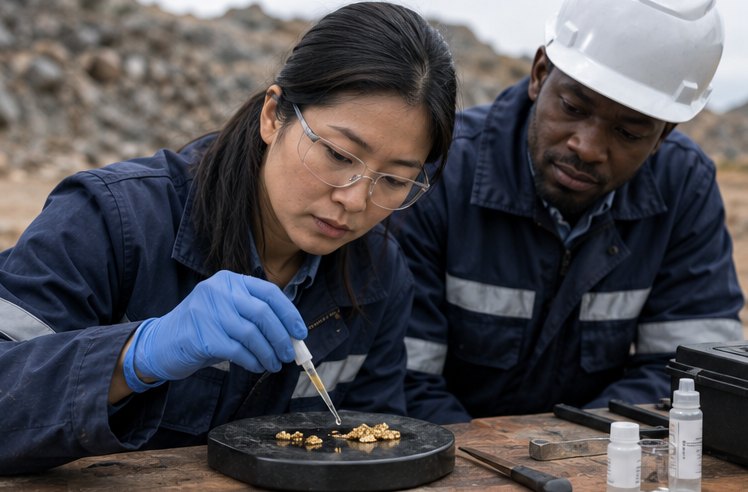
Our tester examines every piece where the gold is held, in front of the parties, with three field methods that cover each other’s blind spots:
- XRF — the elements in the surface layer and their proportions.
- Touchstone and acid — the fineness of the outer metal.
- Hydrostatic density — the density of the whole piece, which reveals a lighter core.
Each piece is numbered, weighed on a calibrated scale, sealed and photographed. Where the sale is settled on gold content, a sample goes under seal to a laboratory accredited to ISO/IEC 17025 for fire assay, the reference method. Raw or alluvial gold can be melted into a bar at a licensed facility in front of our tester, with a sample taken from the melt — a witnessed melt.
How is the chain of custody kept from the vault to the refinery?
Testing proves little if the gold that ships is not the gold that was tested. After testing, the lot and its samples are sealed with numbered seals and photographed; the seal numbers go into the report. At each later step — transport to the airport, export, arrival at the refinery — the seals are checked against the record. A broken or unrecorded seal is reported as a finding.
Where the buyer wants it, an inspector attends the export loading and the handover to the carrier, so the custody record runs unbroken from the vault to the refinery that pays for the metal.
What does the gold buyer receive?
The buyer receives an NGS assessment report under the Nairank Global Standard, with the evidence attached: registry extracts, licence and cadastre records, issuer confirmations, the tester’s readings, weights, seal numbers and photographs, and the laboratory certificate in the buyer’s name when an assay is in scope.
The supplier’s risk is rated Low, Medium or High against the OECD red flags, and the report closes with a written recommendation: proceed, proceed on conditions, or do not proceed. Conditions are drafted so they can go straight into the contract.
How long does gold buyer due diligence take?
| Check | Time |
|---|---|
| Registry and licence check (desk) | 3–5 business days |
| Full supplier due diligence | 7–10 business days |
| On-site inspection or testing | Team on site within 48–72 hours after access is confirmed |
| XRF, acid and density results | Same day, on site |
| Written inspection report | Within 2 business days of the visit |
| Fire assay at an accredited laboratory | 3–5 business days after the sample reaches the lab |
| Urgent desk check | 48 hours, on request |
Times start once we have the supplier’s details and, for site work, confirmed access.
How are fees for gold buyer due diligence set?
Fees depend on the number of companies and countries involved, travel to the site, the laboratory tests needed and the urgency. A fixed quote is agreed before work starts. Fees are outcome-neutral: they are the same whether or not the transaction proceeds, so the report can say what the evidence shows.
How does gold buyer due diligence differ by country?
The registries, licences and export rules change from country to country. Nairank Global has field teams in each of these seven countries:
Tanzania
Company records sit with BRELA and mining licences with the Mining Commission and its online cadastre. Gold is traded through licensed dealers and government mineral markets in Dar es Salaam, Mwanza and Geita. Gold testing in Tanzania.
Kenya
Companies register with the Business Registration Service; dealer and export permits come from the State Department for Mining. Much gold offered for export is presented in Nairobi. Gold testing in Kenya.
Uganda
URSB holds company records and the Directorate of Geological Survey and Mines (DGSM) issues mining and dealer licences; Uganda’s refineries buy from licensed sources. Gold testing in Uganda.
DR Congo
Company records are held by the RCCM and mining titles by CAMI, the mining cadastre; trading houses need ministerial approval. Gold testing in the DR Congo.
Zambia
PACRA holds company records and the Ministry of Mines and Minerals Development runs the mining cadastre and issues export permits. Gold and copper testing in Zambia.
Ghana
The Office of the Registrar of Companies holds company records and the Minerals Commission licences mining. Since 2025 the Ghana Gold Board (GoldBod) is the sole buyer and exporter of small-scale gold. Gold testing in West Africa.
Sierra Leone
Companies register with the Corporate Affairs Commission and mineral rights are administered by the National Minerals Agency. Most gold is exported through Freetown. Gold testing in Freetown.
Which standards does the work follow?
- Inspections are carried out to the requirements of ISO/IEC 17020.
- Laboratory testing is done by laboratories accredited to ISO/IEC 17025; gold fire assay follows ISO 11426.
- Due diligence follows the OECD Due Diligence Guidance five-step framework and LBMA responsible gold guidance.
- Gold fineness is stated against LBMA standards.
How do I start gold buyer due diligence?
Use the request form below: name the seller, describe the gold and where it is held, and upload the documents you have been sent. We reply with the checks we recommend, a timetable and fixed terms. Nothing starts until you approve the scope.