Inspection, Testing & Assaying
On-site gold testing in Africa: XRF, acid, density and fire assay
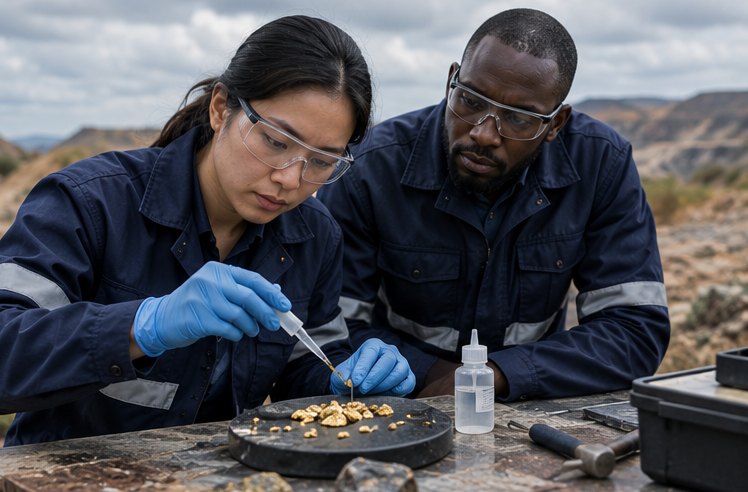
Gold should be tested before it moves and before it is paid for. Our testers attend wherever the lot is held — a mine, a dealer’s office, a vault, a bonded warehouse — test each piece with three independent methods, weigh it on calibrated scales and seal it, and — where the lot will be settled on its gold content — deliver a sealed sample to the laboratory for fire assay.
Scope
- Turnaround
- Field readings during the visit; written field report within one working day; fire assay as the laboratory schedules it, usually within a working week.
- Coverage
- 7 countries, and anywhere in Africa
- Standards
- Inspection to the requirements of ISO/IEC 17020; laboratories accredited to ISO/IEC 17025
Nairank Global keeps testers in Tanzania, Kenya, Uganda, Zambia, the DR Congo, Ghana and Sierra Leone, and deploys them with XRF analysers, test acids, touchstones and density equipment to any location in Africa. The tester works for you, not for the seller or the buyer’s agent, and records every reading in front of the parties present.
No single field method is sufficient on its own. XRF and acid tests read the outer skin of a piece; a density test reads the piece as a whole. A gold-plated bar can pass an XRF test; a bar with a tungsten core can pass a density test, because tungsten and gold weigh almost the same. Used together, the three methods catch what each misses, and where they disagree the lot is not cleared on site.
Field results are indicative. The figure on which gold is bought and sold is the laboratory fire assay. Where the lot is to be settled on its content, our tester draws the assay sample, seals it and delivers it under chain of custody to an ISO/IEC 17025-accredited laboratory, which issues the certificate to you.
Typical situations
- Before paying a seller for gold, or releasing a deposit
- When selling gold and needing an independent record to show a buyer or refiner
- When a refinery, dealer or financier needs a lot checked before taking it in
- When an assay certificate has been offered but not confirmed
Method
Our testers and inspectors are based in Tanzania, Kenya, Uganda, Zambia, the DR Congo, Ghana and Sierra Leone, and deploy with XRF analysers wherever in Africa the material is held.
- STEP 01
Brief
Form of the gold, its location, the approximate quantity and the date you need — by the request form or email.
- STEP 02
Scope and date
We confirm the tests, the tester, the date and the laboratory, and what the report will contain.
- STEP 03
Identification
At the site, each piece is numbered, photographed and weighed on a calibrated scale before any test.
- STEP 04
Three-method testing
XRF, acid and density readings are taken on each piece and recorded as they are read.
- STEP 05
Sampling and sealing
Where fire assay is in scope, a sample is drawn; the lot and the sample are sealed with numbered tamper-evident seals.
- STEP 06
Laboratory and report
The sample goes to the accredited laboratory; you receive the field report at once and the certificate when issued.
Scoping is free. We return a scope, timetable and terms within one business day.
Request this service
Detail
The methods, and what each one shows
XRF (X-ray fluorescence) — a handheld analyser reads the elements present in the surface of the piece in seconds, without damage. It shows gold, silver, copper and other metals and their proportions. It reads only the first fraction of a millimetre, so it cannot see beneath plating or a coating.
Acid and touchstone — the piece is drawn across a touchstone and the streak tested with acids of known strength. The way the streak reacts shows the fineness of the metal at the surface. It is a long-established check that is quick, cheap and difficult to fool with surface treatment alone, but it is still a surface test.
Density — the piece is weighed in air and in water, and its density calculated. Pure gold has a density of about 19.3 grams per cubic centimetre; silver about 10.5; copper about 9.0. A piece that is lighter than its stated fineness implies contains something other than gold. Density reads the whole piece, which is why it catches lead or copper cores that surface tests miss.
Fire assay — at the laboratory, a weighed sample is fused, the precious metals collected and separated by cupellation, and the gold weighed. For gold alloys it follows ISO 11426. It is the reference method on which refiners and central banks settle, and it is the only result we describe as definitive.
What we test
- Doré bars from mines and processing plants
- Cast bars and ingots, including bars that have been resmelted locally
- Nuggets
- Alluvial gold and gold dust
- Jewellery and scrap gold
Where we test
Our testers are based in Tanzania, Kenya, Uganda, Zambia, the DR Congo, Ghana and Sierra Leone and travel from there to wherever the gold is — mine sites, licensed dealers’ premises, mineral markets and buying centres, vaults, bonded warehouses, airports and ports. Where a lot is held in another African country, a tester is deployed with equipment; the date is set in the scope.
Preparing for the visit
Testing goes fastest when the holder of the gold knows what to expect. The lot should be available in one place, with every piece that is to be sold; the holder should agree in advance to weighing, density measurement and, if fire assay is in scope, to a sample being drawn; and a clean, level surface and a supply of clean water are needed for the density test. Our tester brings the analyser, acids, touchstones, scales, seals and evidence bags.
If the lot is in a vault or bonded warehouse, the operator’s consent and the access arrangements should be confirmed before the date. We can arrange this with the operator if you prefer.
What the report contains
- Location, date, time and the people present
- The scale used and its calibration reference
- For each piece: number, description, gross weight, XRF reading, acid result and density
- Photographs of each piece, the readings and the sealing
- Seal numbers for the lot and for each sample
- The chain of custody of the sample to the laboratory
- The laboratory certificate, issued to you, where fire assay is in scope
Deliverables
- A written field report with XRF, acid and density readings for every piece
- Calibrated weights and numbered seals for the lot
- A photographic record of the pieces, the testing and the sealing
- Where in scope, the laboratory’s fire assay certificate, addressed to you
Turnaround. Field readings during the visit; written field report within one working day; fire assay as the laboratory schedules it, usually within a working week.
Why clients choose us
- Three independent methods on every piece, read in front of the parties.
- Testers stationed in Tanzania, Kenya, Uganda, Zambia, the DR Congo, Ghana and Sierra Leone, deployed with equipment anywhere in Africa.
- The laboratory certificate is addressed to you, never relayed through the seller.
- Nairank Global is independent of buyers and sellers. Its fees are outcome-neutral: they are the same whether or not the transaction proceeds. Our fee is agreed before work starts and is the same whatever we find.
Questions
Not answered here? Message the desk.
How does on-site gold testing differ from a gold assay?
Testing is the on-site examination — XRF, acid and density — that shows whether the metal is what it is claimed to be and gives a working estimate of fineness. Assay is the laboratory measurement of gold content, by fire assay, on which a lot is settled.
Which countries do you test in?
Our testers are based in Tanzania, Kenya, Uganda, Zambia, the DR Congo, Ghana and Sierra Leone, and travel to any African country where the gold is held.
How long does testing take?
A typical lot is tested in a single visit, and readings are given on the spot. The written field report follows within one working day. Fire assay usually takes up to a working week, depending on the laboratory.
Is XRF enough on its own?
No. XRF reads only the surface, so plated or coated pieces can pass. It is used with acid and density testing, and fire assay is the final result.
Can a density test be fooled?
Tungsten has almost the same density as gold, so a tungsten-cored bar can pass a density test. That is why density is combined with surface methods, and why a suspect bar should be drilled or melted.
Which laboratory performs the fire assay?
An ISO/IEC 17025-accredited laboratory agreed in the scope, or a national laboratory where the law requires it.
Who receives the laboratory certificate?
You do. The certificate is addressed to the client, so it cannot be substituted on the way.
Do you test small quantities?
Yes. We test single pieces as well as large lots. The scope sets out the tests appropriate to the quantity.
Does testing damage the gold?
XRF and density testing do not. The acid test leaves a small streak on the touchstone, not on the piece. Fire assay consumes a small sample, which is drawn in a way agreed with the owner.
What if the readings disagree?
The lot is not cleared on site. The disagreement is recorded, and we recommend fire assay or melting before any payment.
Can you test gold that is already in a vault or warehouse?
Yes, with the operator’s consent. We test in the vault or warehouse and seal the lot there.
Do you buy the gold or introduce buyers?
No. Nairank Global is independent of buyers and sellers. We test the gold for whoever commissions us, and the result is theirs.
Where we provide this
City and country pages with local detail: where our teams work, the authorities involved and how an engagement runs there.
- Gold testing in Dar es SalaamXRF, acid and density testing at dealers, vaults and the airport, with fire assay and sealed lots.
- Gold testing in MwanzaTesting at Lake Zone mineral markets, dealers and refineries, with witnessed melts and fire assay.
- Gold testing in GeitaGold tested at source in Geita, with inspection of the producing site and sealed lots.
- Gold testing in NairobiGold tested in Nairobi vaults and dealers’ premises, with vault and licence confirmation.
- Gold testing in KampalaTesting at dealers, refineries and Entebbe airport, with seller licence checks.
- Gold testing in LusakaGold testing in Lusaka with site inspection in the provinces and seller checks.
- Gold and copper testing in LubumbashiGold testing and copper and cobalt sampling in Haut-Katanga and Lualaba, with warehouse inspection.
- Gold testing in AccraGold testing and GoldBod and Minerals Commission licence checks for buyers in Ghana.
- Gold testing in FreetownGold testing in Freetown and the provinces, with NMA licence and CAC company checks on the seller.
- Supplier due diligence in TanzaniaBRELA, Mining Commission, authority to sell, inspection and screening.
- Supplier due diligence in KenyaBRS record, Mining Act licences, vault confirmation and testing.
- Supplier due diligence in UgandaURSB, DGSM licences, origin documents and testing.
- Supplier due diligence in GhanaORC, GoldBod and Minerals Commission checks, offtake documents and testing.
- Gold testing and supplier due diligence in Sierra LeoneCAC record, NMA mining, dealer and exporter licences, export documents, inspection and gold testing.
Related practice areas
Gold Melt Supervision & Sampling
Gold Valuation
Mine, Warehouse & Stockpile Inspection
Field guidance
Country pages and buyer guides where this work applies.
- Tanzania — Dar es Salaam, Mwanza, GeitaXRF, density and fire assay in Dar es Salaam, Mwanza and Geita, with BRELA and Mining Commission checks on the seller.
- Kenya — Nairobi, Migori, KakamegaGold testing in Nairobi and western Kenya, with checks on the dealer’s licence class, company record and export approval.
- DR Congo — Bunia, Kinshasa, LubumbashiGold testing and seller checks against RCCM, CAMI, the comptoir licence and CEEC certification.
- Zambia — Lusaka and the CopperbeltCopper inspection and sampling on the Copperbelt, gold testing in Lusaka, PACRA and Mining Cadastre checks.
- Uganda — Kampala, Entebbe, MubendeIndependent testing of incoming lots for refineries, witnessed melts and supplier checks; refinery certificate checks for buyers.
- West Africa — Ghana, Sierra Leone and beyondField teams in Ghana and Sierra Leone, deployed across West Africa, with checks against national rules such as GoldBod licensing.
Gold Testing & Assaying
Brief us on the requirement and the location. We return a scope, a timetable and terms within 24 hours, in confidence.